SEO & Search
Google Site Reputation Abuse Policy Update 2026: SEO, AEO & GEO Playbook
Google updated its Site Reputation Abuse (parasite SEO) spam policy on August 28, 2026—with different EEA vs non-EEA enforcement from August 30. Learn what changed, how to stay safe, and how to optimize for SEO, AEO, GEO, AI Overviews, and Google Discover.
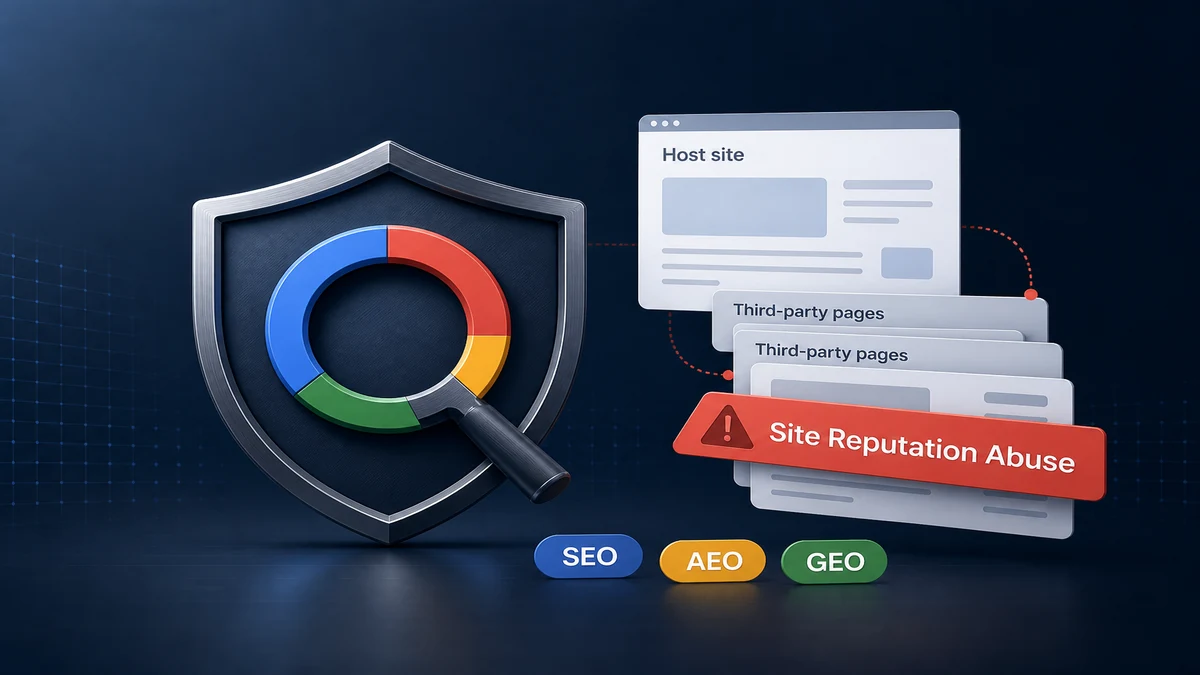
What Google just changed (August 28–30, 2026)
On August 28, 2026, Google Search Central published an update to its Site Reputation Abuse policy—the spam rule aimed at “parasite SEO,” where third-party content rides a trusted domain’s authority to rank. Enforcement behavior splits by geography starting August 30, 2026.
Outside the European Economic Area (EEA), a site reputation abuse manual action still demotes the affected section of the site in Search (the rest of the site stays intact). Inside the EEA, that same manual action no longer applies to what EEA searchers see. Instead, Google may separate the problematic section in its systems so those pages gradually rank on their own merits—without inheriting the host site’s reputation.
Google says the change follows discussion with the European Commission after DMA-related scrutiny of how the policy treated publisher and partner content. Manual action notifications in Search Console continue; reconsideration requests remain; eligible sites can escalate to mediation after reconsideration.
What is the Google Site Reputation Abuse policy?
Site Reputation Abuse (often called parasite SEO or site reputation abuse spam) is when third parties publish content on a high-authority site primarily to exploit that site’s ranking strength—not because the host meaningfully created, supervised, or stands behind the content.
Classic risk patterns include rented subfolders or subdomains filled with affiliate pages, loosely supervised “partner” verticals, and commercial articles that sit far outside the host brand’s expertise. Google introduced stronger policy language in 2024 and has refined how it identifies and enforces against those patterns since.
The August 2026 update does not kill the policy. It changes how penalties show up for EEA search traffic and clarifies identification criteria. If you publish on—or rent space from—a trusted domain, this policy still belongs on your risk checklist.
- Policy goal: stop third-party content from hijacking a host site’s reputation in Google Search
- Typical vectors: sponsored sections, partner microsites, thin affiliate clusters on news/publisher domains
- Host sites can still receive Search Console manual action notices
- Non-EEA searchers can still see demotions for the affected section
- EEA searchers: demotion impact does not apply; section may be ranked more independently over time
EEA vs non-EEA: how enforcement works now
Think of one manual action with two regional outcomes. A page can be flagged globally, but the ranking effect depends on where the searcher is.
For searchers outside the EEA, Google continues to apply the manual action to the violating portion of the site. For searchers inside the EEA (EU member states plus Iceland, Norway, and Liechtenstein), Google will not apply that demotion impact. The company may instead isolate the section so it cannot lean on the parent domain’s signals forever.
Because many pages get traffic from both regions, publishers can see a Search Console manual action while EEA rankings behave differently from US or APAC rankings. Do not assume “no EEA demotion” means “safe everywhere.”
SEO playbook: stay compliant and keep ranking
Classic SEO still wins when content is first-party, useful, and clearly owned. After this update, the bar for “we just host a partner vertical” is higher—especially outside the EEA.
Audit every section that is not written and edited by your core team. Map who created it, who profits from it, and whether readers would reasonably believe it is your brand speaking. If the answer is fuzzy, treat that URL cluster as reputation-abuse risk.
Strengthen technical and on-page SEO the right way: crawlable structure, clear authorship, original reporting or unique insight, fast Discover-friendly media, and internal links that reflect topical authority—not rented authority.
- Inventory subfolders/subdomains with third-party or sponsored commercial content
- Require editorial control, disclosure, and brand alignment for any partner pages you keep
- Prefer first-party guides with E-E-A-T signals (experience, expertise, author, sources)
- Use Search Console Manual Actions + Performance reports weekly after August 30
- If flagged, fix the section, document ownership, then file a reconsideration request
- Build topical clusters you actually own (YouTube growth, packaging, SEO workflows) instead of thin affiliate islands
AEO: Answer Engine Optimization after the update
AEO (Answer Engine Optimization) means structuring content so answer engines—Google AI Overviews, AI Mode, featured answers, voice assistants—can cite you cleanly. Parasite SEO chased rankings; AEO chases being the cited source.
Write pages that answer one primary question early, then expand with evidence. Use descriptive H2s that mirror real queries (“What is site reputation abuse?”, “How does Google enforce site reputation abuse in the EEA?”). Keep definitions short, then add nuance.
Add FAQ blocks with natural-language questions. Mark them up with FAQ schema when answers are unique. Pair how-to sections with concrete steps publishers can execute in Search Console—this is what answer engines prefer over vague opinion essays.
- Lead with a direct definition or verdict in the first 100–150 words
- Use question-style H2s aligned to People Also Ask and AI Overview prompts
- Include dates, entities, and primary sources (Search Central posts) for citability
- Avoid doorway-style partner pages that answer nothing unique
- Refresh answers when Google changes enforcement—stale AEO pages lose citations fast
GEO: Generative Engine Optimization for AI Overviews & AI Mode
GEO (Generative Engine Optimization) focuses on visibility inside generative search: AI Overviews, AI Mode, and generative surfaces in Discover. Google’s Search Generative AI performance reports in Search Console make this measurable via impressions by page—even when clicks are still limited.
Generative systems reward clear entities, original synthesis, and trustworthy structure. A rented coupon gallery on a news domain is weak GEO. An original explainer that quotes Google’s policy, compares EEA vs non-EEA outcomes, and gives a compliance checklist is strong GEO.
For creators and brands, GEO and Senswit’s packaging loop rhyme: decide what to publish, structure the answer, ship assets, then measure. Tool-specific workflows beat raw chat prompts when you need consistent SEO packs and briefs.
- Track Generative AI impressions in Search Console (Search + Discover tabs when available)
- Publish original comparisons and checklists generative models can attribute
- Use consistent entity names: “Site Reputation Abuse policy,” “parasite SEO,” “EEA”
- Ship 1200×675 Discover-friendly images with descriptive alt text
- Link to primary sources (developers.google.com/search) so models can verify claims
Google Discover optimization (and why image quality matters)
Discover loves timely, interest-matched stories with large, clear imagery. Google’s own guidance favors high-quality images—especially large landscape assets suitable for max-image-preview:large. A Discover-friendly cover is typically a sharp 16:9 image around 1200px wide (or larger), with a readable subject and no spammy text walls.
This update is Discover-worthy because it is newsy, policy-driven, and actionable for publishers. Pair the article with a distinct cover (WebP or high-quality PNG/JPEG served responsively), a compelling title without clickbait, and an opening that states the change in one sentence.
Do not chase Discover with doorway domains or scraped partner content. That pattern is exactly what Site Reputation Abuse targets—and it also fails Discover’s quality bar.
Google algorithm & spam signals to watch alongside this policy
Site Reputation Abuse sits inside Google’s broader spam policies. It interacts with your overall quality story: helpful content, scaled content abuse, expired domain abuse, and link spam still matter.
If your growth plan depends on buying placements on authoritative domains, pivot. Invest in owned topical authority, YouTube + web content loops, and measurement (Search Console classic Performance + Generative AI reports).
Creators should treat every “guest” or “partner” page as a compliance review: disclosure, editorial standards, unique value, and brand fit. If you would not put the Senswit logo on it, do not put it on a domain you care about.
- Helpful Content / quality systems — people-first depth beats scaled filler
- Scaled content abuse — mass AI pages without oversight remain risky
- Expired domain abuse — buying old domains for unrelated niches still fails
- Link spam — paid links and manipulative exchanges compound reputation risk
- Manual actions — check Search Console Security & Manual Actions after big updates
Action checklist for publishers, agencies, and creators
Use this as a same-week sprint after the August 2026 update.
- Read Google’s Search Central post: Update to the Site Reputation Policy (August 28, 2026)
- List all third-party, sponsored, and partner URL paths on every property you control
- Decide: take over editorial control, noindex/remove, or relocate to the partner’s own domain
- Add clear authorship, About, and contact pages to strengthen E-E-A-T
- Publish first-party explainers that target SEO + AEO + GEO queries (like this guide)
- Monitor Manual Actions and Generative AI impression reports through September 2026
- If you receive a site reputation abuse action: remediate, document, reconsider, then mediation if eligible
- For creator brands: keep commercial content inside tools and pages you fully own—scripts, SEO packs, and packaging briefs
How Senswit fits a clean SEO → AEO → GEO workflow
Senswit is built as a decide → package → ship → prove loop for creators—not a parasite-SEO shortcut. SEO Pack Studio helps you build titles, descriptions, tags, and chapters for content you actually create. Script Generator AI and Trend Discovery help you publish original angles worth citing.
That matters more after Site Reputation Abuse enforcement matured: sustainable visibility comes from owned expertise and structured packaging, not borrowed domain juice.
Start free with a 7-day Pro trial, then use SEO Pack Studio on your next first-party article or YouTube upload—especially when you are explaining algorithm and policy changes your audience is already searching for.
Frequently asked questions
- What is Google’s Site Reputation Abuse policy?
- It is a Google spam policy against publishing third-party content on a trusted site mainly to exploit that site’s ranking reputation (often called parasite SEO). Google may issue a manual action on the affected section of the site.
- What changed in Google’s Site Reputation Abuse policy in August 2026?
- From August 30, 2026, manual actions under the policy still demote affected sections for searchers outside the EEA. For searchers inside the EEA, that demotion impact does not apply; Google may separate the section so it ranks more independently. Search Console notices and reconsideration remain.
- Does the update mean parasite SEO is allowed in Europe?
- No. Google did not cancel the policy in the EEA. It changed how manual-action demotions affect EEA search results and may isolate offending sections from the host domain’s reputation signals.
- How do SEO, AEO, and GEO differ?
- SEO optimizes for classic Search rankings and clicks. AEO structures content so answer engines can cite clear answers. GEO optimizes for generative surfaces like AI Overviews, AI Mode, and generative Discover features—often measured via generative AI impressions.
- What image size works best for Google Discover?
- Use a large, high-quality landscape image—commonly 1200×675 (16:9) or larger—with a clear subject, strong contrast, and descriptive alt text. Avoid cluttered text-heavy graphics and thin stock crops.
- What should I do if I get a site reputation abuse manual action?
- Remove or take full editorial ownership of the third-party section, fix disclosures and quality issues, then submit a reconsideration request in Search Console. Eligible sites may also access mediation after reconsideration.